

What Is The Makeup Of Fossils That Have Been Discovered
On this folio...
How do fossils form?
Fossils are formed in many dissimilar ways, but most are formed when a living organism (such as a plant or animate being) dies and is apace buried by sediment (such as mud, sand or volcanic ash). Soft tissues often decompose, leaving only the hard bones or shells behind (simply in special circumstances the soft tissues of organisms can be preserved). After the organism has been buried, more sediment, volcanic ash or lava can build up over the height of the buried organism and eventually all the layers harden into rock (they become 'lithified'). It is merely when the process of erosion - when the rocks are worn back downwards and washed away - occurs that these once living organisms are revealed to us from within the stones.

Sheldon Teare observing and working on Eric the Pliosaur in the Material Conservation laboratory. March 2018. Epitome: Nick Langley
© Australian Museum
What does the word fossil mean?
The term fossil literally ways 'dug up', which comes from the Latin word fossilis. A fossil refers to any remains or traces of by life that are preserved in the stone tape. Fossils include the organisms remains, such as plant or animal tissues, shells, teeth or bones and fifty-fifty bacteria (!), but tin can likewise include traces of life such every bit human foot prints or worm burrows. Fossils tell us almost the history of life on World, which we refer to equally the fossil record.
Five common ways that fossils form
- Permineralisation occurs when dissolved minerals carried by ground water fill up space inside the cells of plants and animals. The dissolved minerals crystalise in these cellular spaces and somewhen form rocks in the shape of the animate being or found. This is the most common type of fossil preservation and examples include teeth, bones, shells and wood. We may refer to these fossils as having been petrified.
- Impression fossils form when the organisms original bone or tissue is removed by processes that occur after burial, such every bit footing h2o flow. If the organisms remains are decomposed entirely, leaving an empty infinite in the shape of the organism, it is referred to as a cast. If minerals make full in this empty space and form a mineralised 3D shape of the organism it is referred to every bit a mould. Many marine invertebrates like shells form fossils in this way.
- Amber can preserve organisms if they go trapped in tree resin. The resin will eventually harden to grade a golden amber that has been shown to preserve fossils up to 100 million years one-time.
- Trace fossils record the activity of an organism. They include nests, burrows, footprints and coprolites (ameliorate known as fossilised poo!).
- Soft tissues tin can also be preserved. These include the intact remains of organisms and oft include preserved skin, muscle, bone, hair and internal organs. Soft tissue fossils course in special circumstances that often need rapid burial and depression oxygen environments that end the organism from decomposing or being scavenged by other organisms. These circumstances can occur when the entire organism becomes rapidly encased in textile such equally ice or volcanic ash or cached in peat bogs or trapped in bister! Although this is a rare course of preservation, when it does happen the fossils are exceptionally well-preserved and provide a lot of information about these past forms of life. When fossil sites are found with this kind of exceptional soft tissue preservation they are often referred to as Lagerstätte (which means 'storage identify' in German). An example of this kind of soft tissue preservation comes from the worlds best-preserved woolly mammoth (a baby mammoth named Lyuba) discovered from inside ice that formed xl,000 years ago.

Fish and plant fossil. An Australian xx cent coin can be seen for scale. Paradigm: Yong Yi Zhen
© Australian Museum
How does a dinosaur become a fossil?

Diagram of stage 1 of four of fossilisation process. Image: analogy
© Australian Museum
Stage 1: A dinosaur dies while swimming in a lake. The fleshy parts of the dinosaur decompose, but the hard bones remain intact at the bottom of the lake.
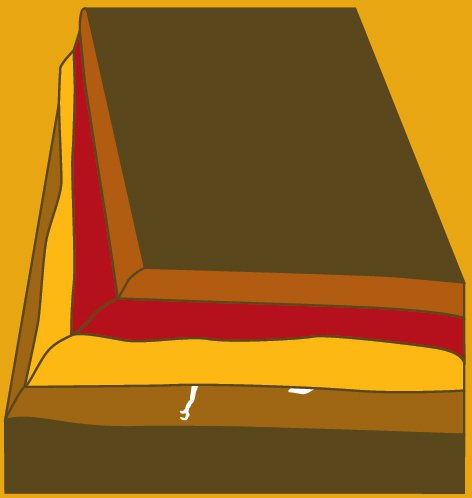
Diagram of stage 2 of 4 of fossilisation process. Image: illustration
© Australian Museum
Stage 2: Sediment builds up over the dinosaur'due south remains, and over fourth dimension a thick sediment bed accumulates on top, protecting the dinosaur bones from scavenging animals.

Diagram of phase three of 4 of fossilisation process. Paradigm: illustration
© Australian Museum
Stage iii: Gradually, the basic are replaced by minerals transported in the basis-water and they turn the bones to stone (this process is known as permineralisation and is described above). As more sediment accumulates over time the pressure and compaction builds up and eventually the bones and sediment layers become the bed rock.

Diagram of stage 4 of 4 of fossilisation process. Paradigm: illustration
© Australian Museum
Stage 4: The dinosaur bones are preserved within the rocks until they are uncovered through erosion or excavated by palaeontologists.
What is the fossil record?
The fossil record refers to the record of life on Globe that has been preserved, discovered, and studied past palaeontologists. But the record is incomplete and often skewed in favour of some organisms over others.
For example, by far the near mutual fossil remains are those of shelled invertebrate creatures such every bit snails, corals, and clams that live in aquatic environments (lakes, river and the body of water).
Fossils of terrestrial (land-based) organisms are much scarcer than those that alive in aquatic environments. In order for these terrestrial organisms to go fossilised, they must either become buried in an aqueous environment similar a lake or a river, or become cached past ash which would occur during a volcanic eruption. Because of this, well-nigh terrestrial organisms never become the chance to get fossilised. At that place may exist whole groups of terrestrial organisms for which no fossil tape has been discovered. But this ways there are many more than discoveries to made about the history of life on Earth! So, we continue to investigate, explore, and uncover the puzzle that is Earth's fossil record.
Source: https://australian.museum/learn/australia-over-time/fossils/how-do-fossils-form/
Posted by: bealsgrany1997.blogspot.com
0 Response to "What Is The Makeup Of Fossils That Have Been Discovered"
Post a Comment